
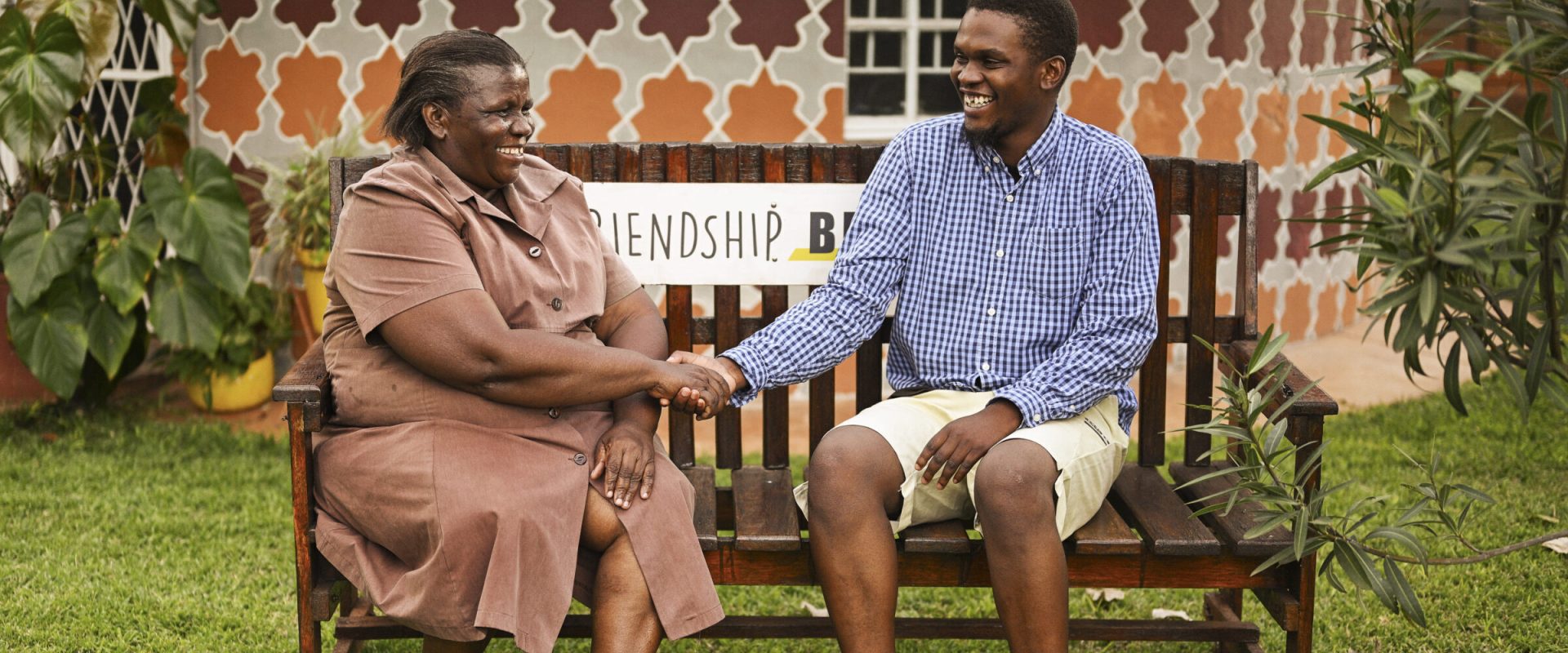
A community-led approach improving access to mental health care in low-resource settings.
Across Southern Africa, mental health conditions remain significantly underdiagnosed and undertreated. An estimated 25–30 per cent of adults will experience a mental health condition in their lifetime, yet fewer than one in ten receive adequate care. In certain settings, depression and anxiety can affect up to 30 per cent of young people. These gaps reflect persistent challenges including limited system capacity, workforce shortages and barriers to accessing care.
In Zimbabwe, the scale of unmet need is particularly stark. Despite growing awareness, up to 70 per cent of people living with mental health conditions today receive no formal support.
The 2025–2026 KBF Africa Prize laureate, Friendship Bench, is addressing this challenge at the primary care and community level. Founded in 2006 by psychiatrist Professor Dixon Chibanda, the model trains lay health workers to provide structured psychological support in discreet, community-based spaces. Many of these providers are older women from local communities, widely known as “grandmothers”, who are equipped to deliver evidence-based talk therapies, including problem-solving therapy and behavioural activation.


“I began this work as one of 16 psychiatrists working in mental health in Zimbabwe and serving a population of 16 million people,” said Professor Chibanda. “We had to find ways to extend care beyond clinics, by working with communities and building on the support systems that were already there.”
“Friendship Bench is a strong example of the African-led innovation the KBF Africa Prize was created to recognise. Rooted in local expertise and scientific evidence, it offers a practical and scalable response to one of the world’s most pressing and neglected health challenges. What began in Zimbabwe is now influencing how mental health care can be delivered around the world.”
Bilikiss Adebiyi-Abiola
Chair of the KBF Africa Prize Selection Committee 2025-2026

Designed to be accessible, culturally acceptable and embedded within everyday life, the Friendship Bench approach reaches people who might not otherwise engage with formal mental health services.
“People come to the bench carrying many different challenges,” explains Gogo Gasa, a Friendship Bench lay health worker. “We listen, we talk, and together we find a way forward. Often, what people need most is someone who will take the time to hear them.”
Today, Friendship Bench operates across Zimbabwe with more than 2,300 trained lay health workers delivering care in communities. In 2025 alone, the programme reached over 334,000 people, contributing to more than 1.1 million lives impacted over time. Outcomes remain consistently strong, with an 85.2% recovery rate and a 51.6% reduction in symptoms within six weeks, including among people with more complex needs.
The model’s strength lies not only in its impact but also in its sustainability. Friendship Bench operates within existing health systems, using established referral pathways, routine data systems and available health staff rather than creating parallel structures. Delivered at an estimated cost of $13–16.50 per client, the approach demonstrates how catalytic funding can support scalable, long-term impact.
More recently, Friendship Bench has been piloted in a range of settings, including the United Kingdom and the United States, highlighting its potential for adaptation across diverse health systems. Building on this experience, the organisation is advancing its ‘Friendship Bench‑in‑a‑Box’ model to support structured scale-up and deeper integration in new contexts. Support from the KBF Africa Prize is expected to accelerate these efforts.
Friendship Bench was selected from nearly 900 applicants by an independent committee of 12 international experts, including former laureates. The committee recognised the programme for expanding access to mental health care through a community-based model that originated in Zimbabwe and is now informing global mental health practice.
“The scale of unmet mental health need across many African countries remains profound,” said Bilikiss Adebiyi‑Abiola, Chair of the KBF Africa Prize Selection Committee 2025–2026. “Friendship Bench shows what becomes possible when care is embedded in communities rather than confined to clinical settings.”
“By training trusted community members and equipping them with evidence-based tools, the model challenges long-standing assumptions about who can deliver mental health care, and where that care can take place.”
For Professor Chibanda, the Prize recognises the central role played by communities themselves. “This award belongs to the grandmothers and community health workers who have made this work possible,” he said. “It shows that when we trust communities and invest in them, we can build systems of care that are both effective and deeply rooted in everyday life.” The KBF Africa Prize provides a grant of €250,000, alongside access to the King Baudouin Foundation’s international network of practitioners and partners. With this support, Friendship Bench aims to further strengthen its model, expand reach and contribute to national and regional efforts to integrate mental health into primary care systems.
 Cookie policy